
From the library
How Indian Moms Say 'I Love You' (Without Ever Saying It)
Sometimes care sounds like ‘Did you eat?’ A personal reflection on food, Punjabi family life, and making room for affection and boundaries.
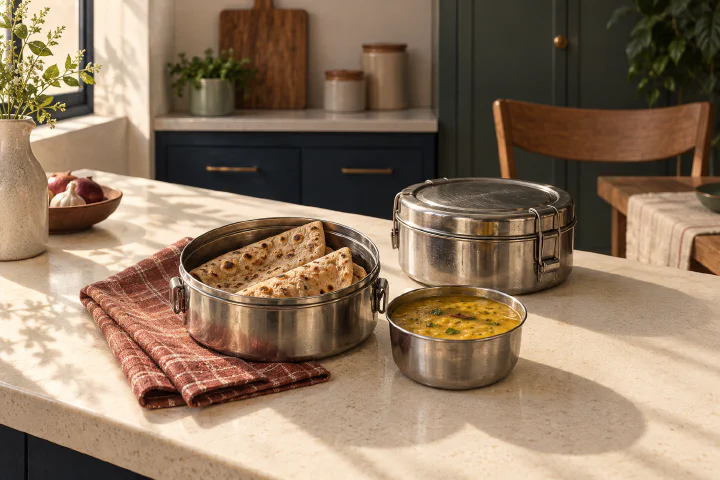
“Did you eat roti today?”
My dad, a grown man with adult children of his own, still gets a call from my grandma every day. In Punjabi, she asks the same question:
“Did you eat roti today?”
When I moved from California to the Midwest, those ordinary questions started to feel different. A call about dinner could also be a way of keeping someone close.
That is one reading of my family’s story. It is not a rule about every Indian mother, every Punjabi household, or what anyone owes their parents.
The care inside an ordinary gesture
A container packed before you leave. Someone remembering which dal you like. A second call to check that you reached home.
For some of us, these gestures carry affection that is rarely spoken directly. For others, the same moment can bring pressure, criticism, or an obligation to put someone else’s feelings ahead of their own.
The gesture alone cannot tell us which it is. We have to leave room for the person receiving it.
Instead of deciding “this is how Punjabi parents love,” a more useful question might be: “What does this mean between us?”
A metaphor, with limits
“Love language” is a familiar way to talk about how people give and receive care. It is less useful when it becomes a fixed label or an explanation for everything a relative does.
A 2024 review by relationship researchers Emily Impett, Haeyoung Gideon Park and Amy Muise found limited support for the idea that everyone has one primary love language, that there are exactly five, or that matching them reliably makes couples more satisfied. That review concerns romantic relationships; it does not establish how Punjabi families express affection.
Here, food as care is a personal and cultural reflection. It is not a biological claim, a personality-test result, or evidence that accepting food improves a relationship.
Something you could actually say
Choose a line that fits your situation. Change it until it sounds like you.
When you appreciate the thought:
“You remembered I like this. Thank you.”
When you are full:
“It looks lovely. I’m full now. Could we save some for tomorrow?”
When you want company more than another serving:
“Could you sit with me for a minute? I’d like to hear about your day.”
When the comments are getting uncomfortable:
“I’m happy to be here. I don’t want to discuss my body or what I’m eating.”
You do not have to use a script, start a difficult conversation, or accept something you do not want. A warm intention and an uncomfortable impact can exist in the same moment.
If this brings up a complicated feeling
Appreciation does not require pretending a relationship has never hurt. You can value a meal and still need an apology, more space, or a different kind of support.
You also do not have to find a positive meaning in every interaction. Your experience belongs in the conversation.
If you want a quiet place to begin, try finding words for a conversation. It lets you draft privately before deciding whether to say anything. Or map what is putting pressure on you and choose one small next step.
Three questions to take with you
- What is one gesture that helps me feel cared for?
- What would I like someone to ask instead of assume?
- What is one limit I want to keep, even when I appreciate the intention?
There is no score and no correct family story. You can just think about one of these and leave it there.
Bring your perspective into the story room →
Updated October 15, 2026 to clarify the research, remove unsupported statistics and biological claims, and make room for different family experiences. This article offers personal reflection and education, not an assessment or clinical advice.
This post is for educational purposes and isn’t a substitute for therapy, diagnosis, or medical advice. If you’re in crisis or experiencing thoughts of self-harm, call 988 (Suicide & Crisis Lifeline) or your local emergency services.
Questions people ask
Is food a love language?
Can I appreciate the gesture and still say no?
What if this does not describe my family?
A little space to let that settle.
Share the article, not someone else’s private story.